
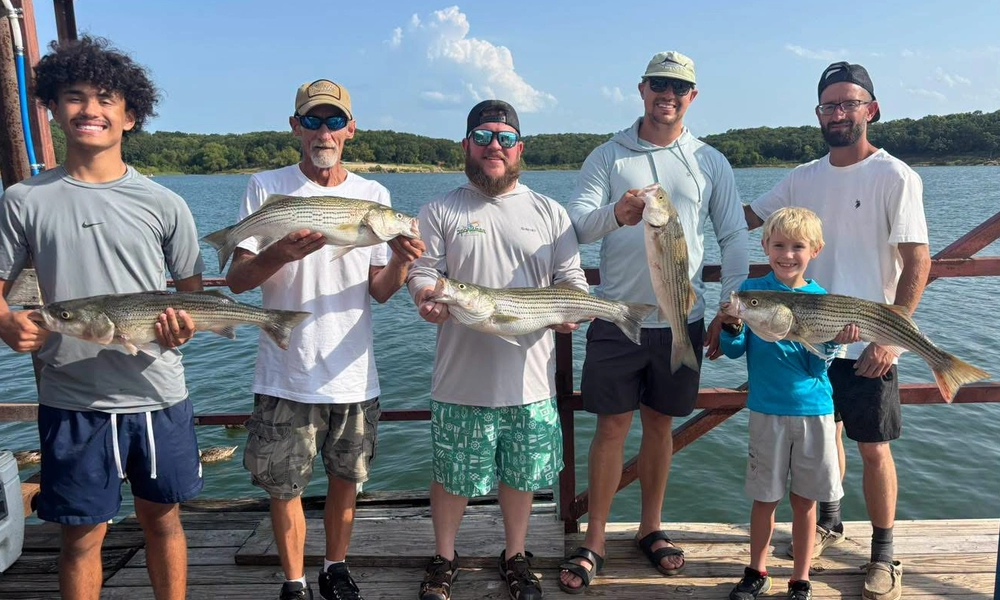
Fall changes Lake Texoma quickly. Cooler nights begin dropping the water temperature, schools of shad change location, and striped bass respond by following their food.
October and November aren’t identical fishing months. October can still carry some late-summer behavior, especially after a warm stretch. By November, repeated cold fronts and longer nights generally push the lake farther into its cool-water pattern.
The constant throughout both months is shad. Find the bait and understand what it is doing, and you’ve taken the biggest step toward finding Lake Texoma stripers.
Quick Answer-Fall Striper Fishing
October and November are excellent months for Lake Texoma fall striper fishing because cooling water changes baitfish movement and can create aggressive striped bass feeding activity. Expect stripers to move between open water, points, flats, creek channels and deeper structure while following threadfin and gizzard shad. Topwater plugs, swimbaits, slab spoons and live shad can all produce, while electronics and feeding birds can help anglers locate fish.
October Starts the Fall Transition
October is best understood as a transition rather than a fixed fishing pattern.
A strong cold front can change the lake quickly. Several warm days can slow the progression. That means anglers shouldn’t arrive assuming the fish must be at a certain depth simply because the calendar says October.
Instead, look at the conditions.
Surface temperature, recent weather, wind direction and bait location provide better clues than the date alone. Lake Texoma striped bass are mobile predators, and much of their movement revolves around finding forage.
As the lake cools, shad distribution changes. Stripers may drive bait toward the surface one morning and be found much deeper later in the day.
This is why covering water and reading electronics is often more productive than repeatedly fishing yesterday’s spot.
November Pushes the Lake Toward Its Cool-Water Pattern
By November, Lake Texoma has normally experienced more cool nights and passing fronts.
That can make November an excellent month to target striped bass.
Stripers are still following shad, but cooler conditions can change where those bait schools concentrate and how the fish attack them. Creek channels, main-lake points, humps, ledges and nearby flats can all become important depending on bait location.
Texas Parks and Wildlife notes that Lake Texoma stripers frequently surface during fall and winter while feeding on threadfin shad, with diving gulls often helping anglers locate the activity.
But don’t assume every November school will be on top.
Some of the day’s most important information may appear on the sonar screen rather than on the surface.
Water Temperature Matters More Than the Date
There isn’t one magic water temperature where Lake Texoma suddenly becomes a fall fishery.
The trend matters.
A lake cooling steadily after several cold nights behaves differently from one that just experienced several unusually warm afternoons.
As the upper water column cools, shad distribution changes. Stripers respond because their food is moving.
Early October may still require searching water associated with late-summer patterns. As fall progresses, bait and stripers can use points, creek mouths, flats and other areas connected to deeper water.
Understanding this seasonal progression is important enough that our Lake Texoma Fishing Seasons guide covers how water temperature, weather, wind and bait movement affect striper behavior throughout the year.
Don’t turn fall fishing into a simple rule such as “fish shallow.” Instead, expect fish to move and search multiple depths until the electronics tell you where the bait and stripers are holding.
Follow the Shad Instead of a Favorite Fishing Spot
One of the easiest ways to waste a fall morning on Texoma is becoming attached to a location.
A point that held hundreds of stripers yesterday can be nearly empty today.
Striped bass move because their food moves.
Threadfin and gizzard shad are central to the Lake Texoma food chain. When large concentrations of bait relocate, stripers can move with them.
Creek-channel intersections, points dropping toward deeper water, humps, ledges and broad flats adjacent to channels are all worth checking.
But structure alone isn’t enough.
A perfect-looking hump with no bait and no fish on sonar is just an underwater hill. Find bait stacked in the water column with larger fish marks positioned around it, and the situation becomes much more interesting.
Electronics Can Save Hours of Searching
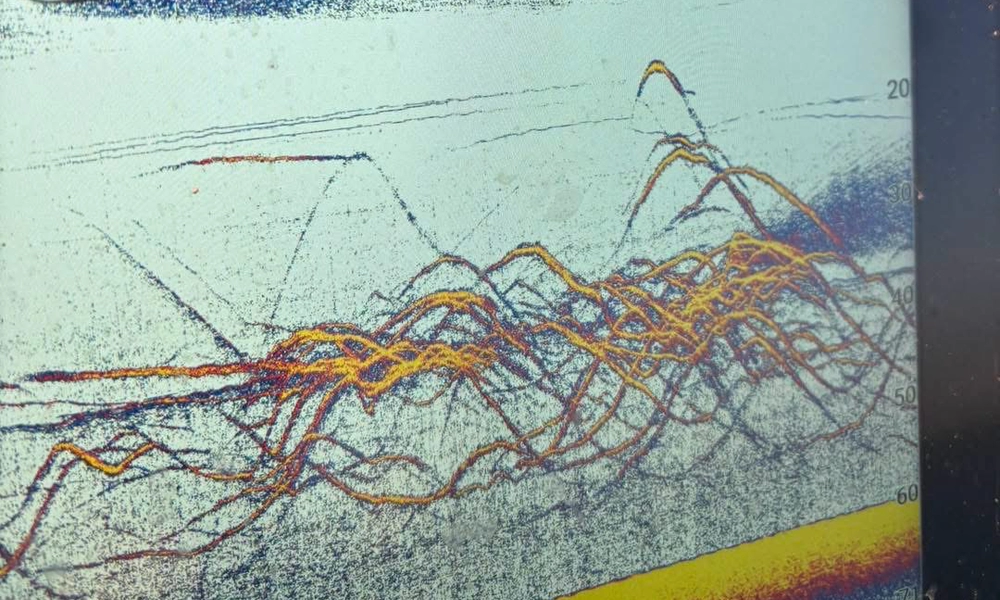
The sonar image on this page shows exactly why electronics matter during fall.
There can be substantial activity beneath the boat while the surface looks completely quiet.
Sonar helps anglers distinguish isolated fish from larger concentrations associated with bait. More importantly, it shows whether stripers are near bottom, suspended in the water column or moving upward behind bait.
Depth matters because the presentation needs to match the fish.
Dropping a slab all the way to bottom doesn’t make much sense if the school is suspended well above it. Running a topwater plug across an empty surface accomplishes little when the entire school is holding deep.
Use electronics to answer three questions:
Is bait present?
Where are the stripers in relation to the bait?
Are the fish moving or holding?
Once those questions are answered, lure selection and boat positioning become much easier.
Watch the Birds, Then Check What’s Under Them
Fall brings another fish-finding tool to Lake Texoma: birds.
Gulls feeding over the lake may reveal shad being pushed toward the surface. Texas Parks and Wildlife specifically notes that gull activity can help anglers locate schooling stripers on Lake Texoma during summer, fall and winter.
But birds aren’t a guarantee.
They can remain in an area after stripers have moved, and not every group of birds means a quality school is directly underneath.
Treat birds as a reason to investigate rather than a command to start casting.
Approach without running directly through the activity. Watch your sonar as you arrive. If the screen confirms bait and stripers underneath, choose a presentation based on the depth of the fish.
Fall Wind Can Help — or End the Fishing Day
Wind is one of the most important variables on Lake Texoma.
A moderate wind can push bait toward a shoreline, point or section of a flat. That concentration of forage can create an excellent striper feeding opportunity.
Wind also affects boat positioning.
Instead of fighting it constantly, anglers can sometimes use a controlled drift to move live bait or artificial lures through roaming schools. On other days, holding directly over concentrated fish is necessary for vertical presentations.
Our guide to how weather affects striper fishing on Lake Texoma goes deeper into the relationship between wind, water temperature, bait movement and changing fishing conditions.
The important distinction is between productive wind and unsafe wind.
Lake Texoma covers nearly 75,000 acres and has large stretches of open water. Strong wind can build rough conditions quickly.
No fishing pattern is worth taking unnecessary chances.
Topwater Fishing Can Be Outstanding in Fall
Few Lake Texoma bites are more exciting than a striped bass exploding on a topwater plug.
Fall provides legitimate opportunities for it.
When stripers drive shad toward the surface, walking plugs and other shad-imitating surface lures can produce aggressive strikes. TPWD specifically lists surface lures among productive presentations when Texoma stripers are feeding near the surface.
Don’t automatically leave when the visible feeding ends.
The school may simply have dropped below the surface.
This is the time to look at sonar and change presentations. A swimbait or slab spoon may continue catching fish long after the surface eruption disappears.
Swimbaits Cover Water and Match Fall Forage
Soft-plastic swimbaits are extremely useful when stripers are actively chasing shad but aren’t consistently breaking the surface.
They can be counted down to different depths, retrieved through suspended schools and worked across points or along channel edges.
Retrieve speed should match the fish.
Aggressive stripers may chase a faster-moving bait. Fish that are deeper or less active may respond better to a slower presentation kept in the strike zone.
One mistake is deciding in advance exactly how a swimbait should be retrieved.
Let the fish answer that question.
Change depth, speed and retrieve until you establish what is producing.
Slab Spoons Shine When Fall Stripers Move Deeper
Slab spoons have been catching Lake Texoma stripers for decades because they get down quickly and imitate the baitfish stripers are already eating.
Lake Texoma guide Steve Buckley describes slab spoons as a year-round striper lure that can be fished vertically through a school or cast and worked back toward the boat. Buckley also notes that popular slab colors include chartreuse and glow white, with weights commonly ranging from one to three ounces depending on wind and fish depth.
Anglers who want to dig deeper into the technique can read Buckley’s Lake Texoma slab spoon fishing information.
Depth control is critical.
When electronics show stripers below the boat, a heavy slab reaches them quickly. That’s particularly valuable when a school is moving and the boat has only a short window over the fish.
If the stripers are suspended, don’t automatically drop the slab to bottom. Put the lure where the fish are showing.
Vertical jigging can produce, but so can dropping a slab through a school and retrieving it upward. Watch the sonar, remember where bites occur and repeat what works.
Live Shad Remain a Reliable Fall Option
Artificial lures receive plenty of attention in fall because surface feeding can be spectacular, but live threadfin and gizzard shad remain highly effective for Lake Texoma striped bass.
Lake Texoma guide Aaron Sharp’s Lake Texoma Live Bait Manual provides a detailed look at live-shad fishing and identifies roughly 15 to 30 feet as a common range during fall bait migration. More importantly, Sharp emphasizes matching bait depth to the fish actually showing on sonar.
That’s the important lesson.
Don’t fish 20 feet simply because someone caught them there yesterday. If the stripers are suspended at a different depth today, put the bait where the fish are.
Boat positioning matters as well. Sharp’s live-bait material recommends drifting when fish are roaming and anchoring when fish are concentrated.
The goal isn’t simply putting a live shad in the lake.
The goal is putting a healthy shad in the strike zone.
For anglers specifically planning an October or November trip, Sharp’s Fall Lake Texoma Striper Fishing guide provides another guide-level perspective on the season.
That’s exactly how fall Texoma fishing should be approached.
Don’t decide before leaving the marina that it’s a topwater day, slab day or live-bait day.
Find the fish first. Then choose the presentation.
Boat Position Is Part of the Presentation
Finding fish is only half the job.
The next challenge is staying with them without ruining the opportunity.
Fall schools can move rapidly while chasing shad. Driving directly through surface-feeding stripers can scatter bait and break up the activity.
Approach carefully and anticipate where the school is moving.
For vertical fishing, boat control becomes even more important. Wind can push the boat away from a school before a lure reaches the proper depth.
A great sonar screen followed by poor boat positioning can still produce poor fishing.
The boat, electronics and presentation need to work together.
Water Clarity Can Change the Presentation
Lake Texoma conditions vary across a huge reservoir.
Recent rain, inflow, wind and location can all affect water clarity.
Texas Parks and Wildlife characterizes Texoma’s normal clarity as moderate to clear, but local conditions can obviously vary across the reservoir.
In clearer water, natural shad profiles can make sense.
In stained water, lure visibility, vibration and profile may become more important.
Clarity can also affect how closely the boat approaches shallow or surface-feeding fish. When fish are spooky, backing away and making longer casts can keep a school active longer.
Cold Fronts Can Rearrange the Lake
North Texas fall weather doesn’t always change gradually.
A strong front can bring falling temperatures, a wind shift and dramatically different boating conditions in a matter of hours.
Don’t automatically expect the same fishing after a front that you experienced before it.
Bait can relocate. Surface activity may disappear. Stripers may change depth.
That doesn’t necessarily mean the fish stopped feeding.
It can simply mean yesterday’s presentation is no longer reaching them.
When a previously productive area suddenly looks dead, expand the search. Check nearby deeper water, channel edges and areas where wind may have moved bait.
Don’t Leave Feeding Fish Too Quickly
Fall stripers create a temptation that catches plenty of anglers.
A school erupts on top. Everyone casts. The surface suddenly goes quiet.
The immediate reaction is to start the motor and search for another school.
Before leaving, check the electronics.
Stripers that were attacking shad on top may still be directly underneath the boat. Changing from topwater to a swimbait or slab can turn a short feeding frenzy into a much longer fishing opportunity.
The surface tells you where the fish were.
Sonar can tell you where they went.
October or November: Which Month Is Better?
Both can be excellent, but they offer slightly different fishing.
October generally provides warmer afternoons and more overlap between late-summer and established fall techniques. Surface feeding can be part of the equation, but deeper fish should never be ignored.
November normally brings more sustained cooling. The fishery progresses farther into its cool-water cycle, while concentrations of shad can produce strong feeding activity.
Neither month guarantees easy fishing.
Wind, cold fronts, water temperature and bait movement can make one October day fish more like November—or make a warm November afternoon feel more like October.
For anglers planning a trip, choosing between the two months matters less than understanding the conditions when you arrive.
Fall Is a Good Time to Take Kids Striper Fishing
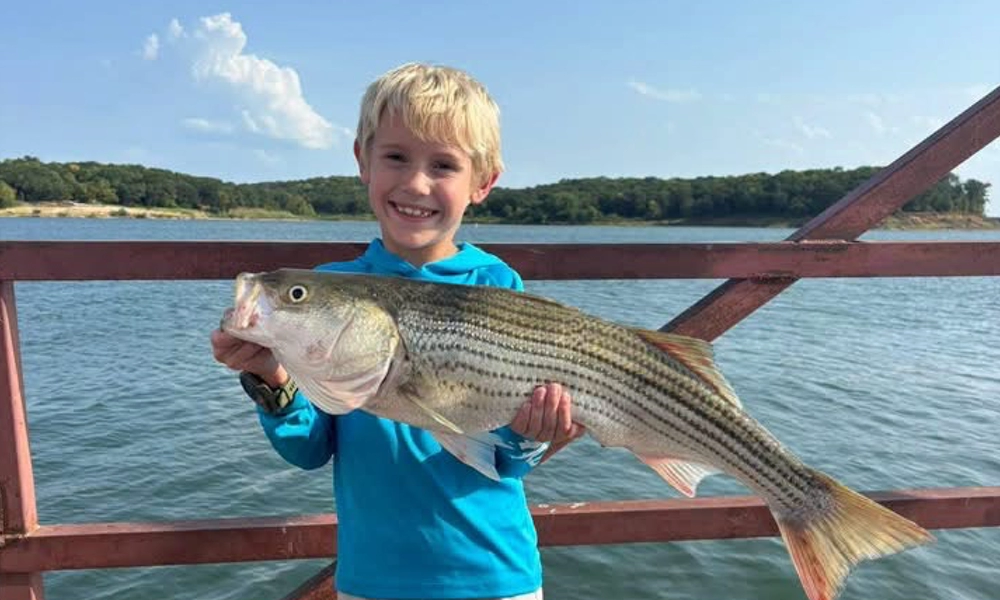
The fishing photos on this page show another advantage of the fall season.
Striper fishing isn’t limited to highly experienced anglers.
Once a school is located and actively feeding, many of the basic techniques can be learned quickly. That makes guided striper fishing well suited to families and groups with different levels of experience.
Cooler fall weather can also be more comfortable than the extreme heat of summer.
The biggest variable is wind.
Families with younger anglers should pay close attention to the forecast and dress for changing temperatures. A chilly early-morning run across open water feels very different from a warm afternoon at the marina.
Layers, rain protection and suitable footwear are worth bringing.
Know the Lake Texoma Striper Regulations Before Fishing
Lake Texoma has special striped bass regulations that differ from Texas’ general statewide striper rules.
Current TPWD Lake Texoma regulations list a 10-fish daily bag for striped and hybrid striped bass in combination, with no minimum length. Only two fish 20 inches or longer may be retained per day. The possession limit is 20, and culling striped or hybrid striped bass is prohibited.
Licensing deserves attention because Lake Texoma spans Texas and Oklahoma.
Texas Parks and Wildlife states that anglers fishing Texas or Oklahoma waters need the appropriate state license unless they possess a Lake Texoma fishing license, which allows fishing across the lake subject to applicable regulations.
Always verify current regulations before fishing because rules can change.
Lake Texoma Fishing Resources
Lake Texoma Fishing Seasons — When Stripers Bite Best — Learn how striped bass patterns change from spring through winter as water temperature, bait movement and weather conditions change.
How Weather Affects Striper Fishing on Lake Texoma — A deeper look at wind, fronts, water temperature, baitfish movement and how changing weather affects Lake Texoma stripers.
When Do Stripers Spawn on Lake Texoma? — Learn how the spring spawning cycle affects seasonal striped bass movement and how the fishery transitions through the year.
Bonus Resource
Texas Parks and Wildlife — Fishing Lake Texoma provides official information about Lake Texoma fishing, reservoir characteristics, fishing opportunities, licensing considerations and invasive-species requirements. TPWD should also be checked before every trip for current fishing regulations.
Frequently Asked Questions
Is October a good month for striper fishing on Lake Texoma?
Yes. October is an excellent transition month as cooling water changes shad movement and striped bass activity. Fish may feed on the surface or concentrate around points, creek channels, humps and open-water bait schools.
Is November good for striped bass fishing on Lake Texoma?
Yes. November can provide excellent Lake Texoma striper fishing as cooler water concentrates bait and stripers continue feeding heavily before winter.
How deep are Lake Texoma stripers during fall?
Depth changes with weather, bait movement and water temperature. Aaron Sharp’s live-bait material identifies roughly 15 to 30 feet as a common fall bait-migration range, but anglers should use sonar to determine the actual depth of bait and stripers each day.
What are the best lures for Lake Texoma stripers in the fall?
Topwater plugs, soft-plastic swimbaits and slab spoons are productive fall striper lures. The best choice depends on whether fish are feeding on the surface, suspended around bait or holding deeper.
Where do Lake Texoma stripers go in October and November?
Stripers follow shad rather than staying in one location. Productive areas can include main-lake points, creek mouths, flats near channels, humps, ledges and open water where electronics show concentrated bait.
Can you catch Lake Texoma stripers on topwater lures in the fall?
Yes. Lake Texoma stripers frequently surface during fall while chasing shad. TPWD specifically identifies fall as one of the seasons when Texoma stripers frequently surface and attract feeding gulls.
What is the Lake Texoma striped bass limit?
Lake Texoma’s current Texas regulations allow 10 striped and hybrid striped bass in combination per day with no minimum length. Only two fish 20 inches or longer may be retained daily, the possession limit is 20, and culling is prohibited.
Lake Texoma Fall Striper Fishing: What to Expect in October and November
Lake Texoma fall striper fishing in October and November revolves around three things: cooling water, moving shad and mobile striped bass. October begins the transition away from warmer-water patterns, while November normally brings more established cool-water conditions.
Don’t choose a fishing depth based only on the calendar. Use electronics to locate bait and stripers, then adjust the presentation to the depth and activity level of the fish. Main-lake points, creek mouths, channel edges, humps, ledges, flats and open water can all produce when bait is present.
Topwater plugs can be outstanding when stripers push shad to the surface. Swimbaits let anglers cover different depths, while slab spoons are excellent for reaching deeper or suspended schools. Live threadfin and gizzard shad remain dependable fall options when presented at the depth where stripers are feeding.
Above all, stay adaptable. Wind, cold fronts, water clarity, water temperature and bait movement can change a productive pattern quickly. During October and November, finding the shad and matching the depth of the stripers is usually the shortest path to finding Lake Texoma fish.