
Lake Texoma Live Bait Fishing Guide: Best Baits, Rigs & Techniques for Striped Bass
Lake Texoma is widely recognized as one of the premier striped bass fisheries in the United States. Every year, anglers travel from across Texas, Oklahoma, and beyond to experience outstanding fishing and the opportunity to catch hard-fighting striped bass. While artificial lures produce exciting action under the right conditions, live bait continues to be one of the most consistent and productive techniques used by professional Lake Texoma fishing guides.
Threadfin shad and gizzard shad make up the primary forage for striped bass throughout the lake. By presenting live bait naturally at the correct depth, anglers can imitate the food stripers feed on every day. Success depends on much more than simply hooking a live shad. Water temperature, seasonal fish movement, sonar interpretation, boat positioning, and proper rigging all play an important role in consistently catching fish.
Whether you are planning your first guided fishing trip or want to improve your own skills, this guide explains the equipment, bait, rigs, and techniques that experienced Lake Texoma guides use throughout the year.
Quick Answer
Live bait fishing is one of the most effective ways to catch striped bass on Lake Texoma because it closely matches the threadfin and gizzard shad that make up their natural diet. Professional fishing guides use healthy bait, quality electronics, and proven rigs to present live shad at the proper depth throughout the water column. By understanding seasonal fish movements and adjusting to changing conditions, anglers can consistently catch striped bass during every season.
Understanding Lake Texoma’s Striped Bass Ecosystem
Lake Texoma is unique among many reservoirs because it supports one of the few self-sustaining striped bass fisheries in the country. The combination of natural reproduction, annual stocking, abundant forage, and excellent water quality creates ideal conditions for striped bass to thrive.
Everything begins with baitfish.
Large schools of threadfin shad and gizzard shad constantly move throughout the lake in search of plankton, comfortable water temperatures, and adequate dissolved oxygen. Striped bass spend much of their lives following these baitfish rather than remaining in one location.
This explains why successful anglers spend as much time looking for bait as they do looking for fish.
Professional guides rarely return to yesterday’s successful location without first checking their electronics. Wind, current generation, weather, and water temperature can move both bait and stripers several miles in a single day.
Learning to locate bait is often the first step toward finding active striped bass.
Why Live Bait Continues to Outperform
New fishing lures enter the market every year, and many of them catch fish. However, live bait remains one of the most dependable presentations because nothing perfectly duplicates the appearance and behavior of a healthy baitfish.
A live threadfin shad constantly produces natural flashes, vibrations, and swimming movements that cannot be completely replicated with artificial lures. Those subtle movements often trigger feeding instincts even when striped bass are not actively chasing faster presentations.
Live bait also excels when fishing conditions become difficult.
During the heat of summer, cold winter months, or periods of heavy fishing pressure, striped bass often become less aggressive. Instead of chasing fast-moving lures, they may prefer an easy meal that drifts naturally through the water.
Professional Lake Texoma fishing guides frequently choose live bait when:
- Fish are suspended over deep water.
- Water temperatures reduce feeding activity.
- Fishing pressure is high.
- Families with children are onboard.
- Beginning anglers are learning striped bass fishing.
- Clients want consistent action throughout the day.
Live bait allows guides to adapt to changing conditions by drifting, downlining, slow trolling, or free-lining healthy shad while adjusting depth as fish move throughout the lake.
Choosing the Right Shad Throughout the Year
The two primary baitfish used on Lake Texoma are threadfin shad and gizzard shad. Both are extremely effective, but each serves a different purpose depending on the season and the size of fish being targeted.
Threadfin Shad
Threadfin shad are the most commonly used live bait on Lake Texoma. Measuring approximately two to five inches in length, they closely match the forage striped bass naturally consume throughout the year.
Their smaller profile makes them an excellent choice for anglers who want steady action and high numbers of fish.
Threadfin shad are commonly used during:
- Spring fishing
- Summer fishing
- Early morning schooling activity
- Family fishing trips
- Days when stripers are feeding aggressively
Because threadfin shad are constantly available throughout much of the lake, they remain the preferred bait for many professional guides.
Gizzard Shad
When larger striped bass become the primary target, many guides switch to gizzard shad.
Gizzard shad typically range from five to ten inches in length and offer a much larger meal for trophy-sized fish. While larger bait may reduce the overall number of bites, it frequently increases the average size of the striped bass caught.
Advantages of gizzard shad include:
- Larger bait profile
- Excellent trophy fish bait
- Better visibility in stained water
- Strong swimming action
- Greater durability on the hook
Experienced guides often adjust bait size throughout the day depending on fish activity and their clients’ goals.
Matching Natural Forage
One reason live bait performs so consistently is because it is exactly what striped bass expect to find.
Unlike many freshwater predators that feed on bluegill, perch, or crawfish, Lake Texoma striped bass spend much of their lives chasing schools of shad.
Presenting healthy threadfin or gizzard shad creates an incredibly realistic presentation that requires very little effort from the angler.
Rather than trying to imitate natural forage, live bait simply is the natural forage.
Essential Live Bait Equipment
Professional fishing guides rely on dependable equipment that performs consistently throughout hundreds of trips every year. Live bait fishing does not require complicated tackle, but properly matched equipment helps anglers detect more bites, land more fish, and keep bait swimming naturally.
Rod Selection
Most Lake Texoma live bait rods measure between seven and eight feet in length with medium-heavy power and a moderate action.
These rods provide enough backbone to control large striped bass while remaining forgiving enough to absorb sudden runs without pulling hooks free.
Longer rods also help separate multiple fishing lines around the boat while reducing tangles during active bites.
Reel Selection
A smooth drag system is one of the most important features of any reel used for striped bass fishing.
Stripers are powerful fish capable of making long, fast runs immediately after being hooked. A quality spinning or baitcasting reel with a consistent drag helps anglers fight fish efficiently while protecting lighter leaders.
Reliability is far more important than owning the most expensive reel available.
Fishing Line
Many professional Lake Texoma guides prefer braided main line because it offers excellent sensitivity and very little stretch.
The increased sensitivity allows anglers to detect subtle bites while maintaining solid hook penetration.
A fluorocarbon or monofilament leader provides abrasion resistance around rocks, timber, and the rough mouths of striped bass while remaining less visible underwater.
Leader length often varies depending on water clarity and fishing conditions.
Circle Hooks
Circle hooks have become the standard for many professional striped bass guides.
Unlike traditional J-hooks, circle hooks are designed to rotate naturally into the corner of the fish’s mouth as steady pressure is applied.
Benefits include:
- Excellent hook-up percentages
- Reduced deep hooking
- Easier fish release
- Improved fish survival
- Better conservation practices
Rather than making a hard hookset, anglers simply begin reeling as the rod loads under pressure.
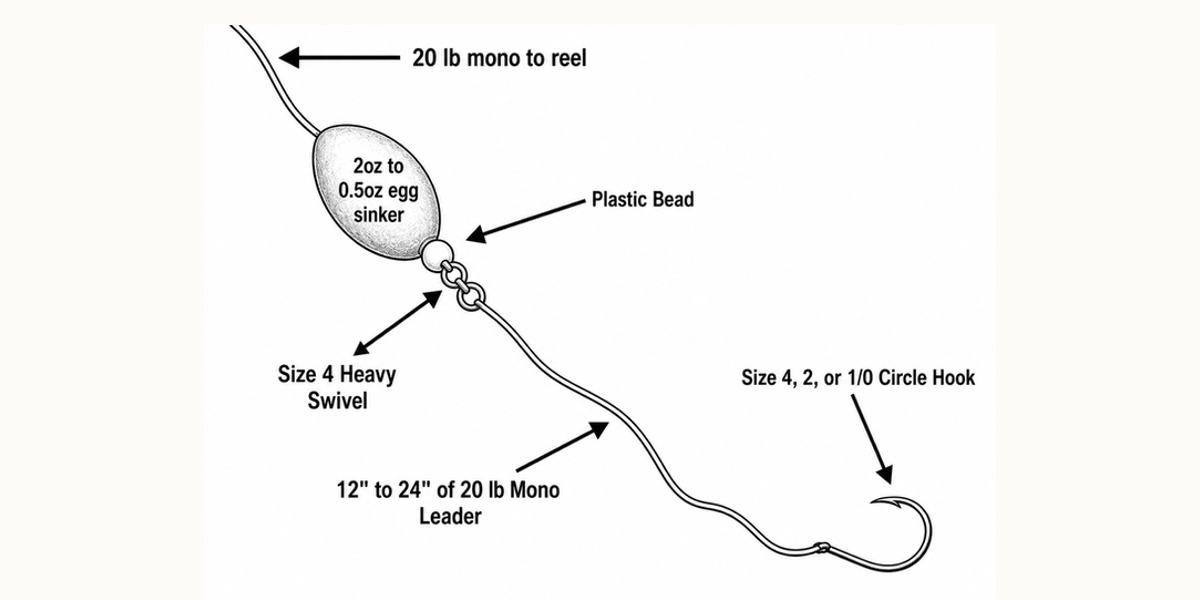
Standard Live Bait Rig
One of the most productive live bait rigs used on Lake Texoma includes:
- 20-pound braided or monofilament main line
- Sliding egg sinker
- Plastic bead
- Heavy-duty barrel swivel
- 12- to 24-inch monofilament leader
- Circle hook matched to bait size
This simple rig allows the baitfish to swim naturally while maintaining excellent depth control throughout the day.
Professional guides often make small adjustments to sinker weight, leader length, and hook size based on wind, current generation, and the depth of suspended striped bass.
Keeping Live Shad Healthy
Healthy bait catches more fish.
Professional fishing guides know that lively shad naturally attract striped bass because they swim, flash, and react just like the forage fish stripers feed on every day. Weak or dying bait loses much of its natural appeal and should be replaced regularly throughout the trip.
Most guides keep bait in large aerated bait tanks designed to maintain proper oxygen levels and stable water temperatures. Crowding too many shad into a small tank quickly reduces oxygen, creates excess waste, and increases stress on the bait.
Water temperature is equally important. During the summer months, cooler water helps reduce stress and keeps bait active much longer. Many guides partially exchange water throughout the day or use specialized bait tank additives to improve water quality.
Handle shad as little as possible.
Removing the protective slime coat can shorten the life of the bait and reduce its natural swimming ability. Wet hands or soft mesh bait nets help minimize damage when transferring bait from the tank to the hook.
A lively baitfish will always outperform one that is struggling.
Finding Fish with Sonar and Electronics
The biggest advantage professional Lake Texoma fishing guides have is not expensive boats or fancy rods.
It’s information.
Modern sonar allows guides to quickly identify bait schools, suspended striped bass, underwater structure, and depth changes that would have been impossible to locate just a few decades ago.
Rather than fishing empty water, experienced guides use electronics to make informed decisions before ever dropping a bait overboard.
GPS Mapping
GPS mapping helps guides navigate safely while locating productive underwater features such as river channels, humps, long points, creek mouths, and submerged roadbeds.
Many productive areas cannot be identified simply by looking at the shoreline.
Digital mapping allows guides to return to productive locations while following seasonal migration routes that striped bass commonly use throughout the year.
Traditional 2D Sonar
Two-dimensional sonar remains one of the best tools for locating suspended baitfish and striped bass.
Large schools of threadfin shad often appear as dense clouds, while striped bass usually appear as distinct arches or groups of fish holding above, below, or alongside the bait.
Experienced guides constantly monitor their electronics while drifting because fish may move several feet higher or lower in the water column throughout the day.
Small depth adjustments often make a dramatic difference.
Side Imaging
Side imaging expands the search area far beyond what traditional sonar can display directly beneath the boat.
This technology helps guides locate schools of baitfish, isolated fish, underwater timber, and structure extending well to either side of the boat.
Rather than driving directly over fish and potentially spooking them, guides can identify productive areas from a distance before positioning the boat.
Forward-Facing Sonar
Forward-facing sonar has dramatically changed the way many Lake Texoma guides fish.
Instead of looking beneath the boat, anglers can watch fish moving ahead of the boat in real time.
This technology allows guides to:
- Track moving schools of striped bass.
- Watch fish approach live bait.
- Adjust bait depth immediately.
- Stay with actively feeding fish.
- Reduce time spent fishing unproductive water.
Although electronics continue to evolve, they remain tools rather than guarantees. Successful guides combine technology with years of local experience to understand where striped bass are likely to move throughout changing conditions.
Seasonal Live Bait Strategies
Striped bass behavior changes throughout the year as water temperature, oxygen levels, bait movement, and spawning activity influence where fish spend their time.
Understanding these seasonal patterns allows anglers to consistently locate fish rather than relying on luck.
Spring
Spring is one of the most productive seasons for live bait fishing.
As water temperatures rise, striped bass become increasingly active and feed heavily before and after spawning activity. Fish often move into river channels and upper portions of the lake while following large schools of bait.
Threadfin shad are extremely productive during this time, and anglers frequently find fish suspended over channels or feeding along points during low-light periods.
Summer
Summer fishing often requires more precise depth control.
As surface temperatures increase, striped bass typically suspend over deeper water where oxygen levels remain favorable.
Professional guides rely heavily on sonar to locate bait schools before presenting live shad directly above or within suspended fish.
Boat positioning becomes increasingly important during summer because fish frequently move throughout the day while following bait.
Fall
Cooling water temperatures trigger aggressive feeding.
Striped bass begin chasing baitfish over large areas of the lake, and schooling activity becomes increasingly common.
Both threadfin and gizzard shad produce excellent results during the fall as fish feed heavily before winter.
Wind-blown points and open-water bait schools often provide outstanding opportunities.
Winter
Cold water slows fish metabolism but does not stop feeding activity.
Striped bass often remain grouped together over deeper water, making electronics extremely valuable.
Live bait presentations become slower and more deliberate, with careful depth control becoming one of the most important factors for success.
Winter frequently produces some of the largest striped bass of the year.
Selecting the Right Live Bait Presentation
Different fishing situations require different presentations.
Professional Lake Texoma guides continually adjust their approach based on fish location, water depth, wind, and current generation.
Downlining
Downlining is one of the most productive live bait techniques used on Lake Texoma.
A weighted rig carries the bait directly to suspended fish while allowing the shad to swim naturally within the strike zone.
Because the bait remains at a consistent depth, downlining is extremely effective when sonar shows fish holding over open water.
Free-Lining
When striped bass move into shallow water or begin feeding near the surface, free-lining allows a live shad to swim naturally without additional weight.
This presentation is especially productive during calm mornings, schooling activity, or whenever fish become reluctant to strike heavier rigs.
Drift Fishing
Drift fishing allows anglers to cover large areas of open water while presenting multiple live baits at various depths.
Using wind or gentle current, guides slowly move across productive areas while monitoring sonar for active fish.
When a concentration of stripers is located, adjustments can be made immediately to keep every bait within the productive depth zone.
Slow Trolling
Slow trolling combines boat control with live bait presentations to cover water more efficiently.
This technique helps guides stay with moving schools of striped bass while presenting healthy bait naturally through the water column.
Speed is kept to a minimum to avoid stressing the baitfish.
Boat Positioning
Boat control is one of the least appreciated skills in striped bass fishing.
Even with quality electronics and healthy bait, poor positioning can dramatically reduce success.
Professional guides constantly adjust their boats to compensate for wind, current generation, and fish movement.
Rather than anchoring in one location, they often reposition multiple times throughout the day to maintain the best presentation angle.
The objective is simple:
Present the bait naturally without spooking the fish.
Sometimes moving only twenty or thirty yards completely changes the bite.
Wind and Current Generation
Wind and water generation from Denison Dam influence striped bass movement throughout Lake Texoma.
Current often concentrates baitfish along channels, points, and underwater structure, creating predictable feeding opportunities.
Wind performs a similar function by pushing plankton and baitfish toward wind-blown shorelines and points.
Experienced guides learn to recognize how these forces affect fish location and adjust their fishing strategy accordingly.
Instead of fighting the conditions, successful anglers use them to their advantage.
Fishing the Strike Zone
One of the biggest mistakes anglers make is fishing at the wrong depth.
Striped bass commonly suspend several feet above baitfish because they naturally feed upward.
A bait presented too deep may never be noticed, even if fish appear nearby on sonar.
Professional guides continually adjust bait depth as fish move throughout the day.
Sometimes raising a bait only a few feet produces immediate results.
Consistently fishing within the strike zone is often the difference between an average day and an outstanding one.
Live Bait vs. Artificial Lures
Both live bait and artificial lures catch striped bass on Lake Texoma, and experienced anglers often use both during the same trip. The key is understanding when each presentation offers the greatest advantage.
Live bait excels when fish become less aggressive or suspend over deep water. A healthy threadfin or gizzard shad creates natural movement that striped bass recognize immediately. Because it closely matches the forage they feed on every day, live bait often produces steady action throughout changing conditions.
Artificial lures become an excellent choice when striped bass are actively chasing bait near the surface or feeding aggressively. Topwater plugs, swimbaits, slab spoons, and umbrella rigs allow anglers to cover water quickly and trigger reaction strikes from schooling fish.
Professional Lake Texoma fishing guides frequently switch between live bait and artificial lures as conditions change throughout the day. Understanding both techniques gives anglers the flexibility to stay productive regardless of fish activity.
| Live Bait | Artificial Lures |
|---|---|
| Natural presentation | Covers water quickly |
| Excellent for suspended fish | Great for schooling fish |
| Consistent throughout the year | Ideal for aggressive feeding periods |
| Best for beginners and families | Requires more casting and lure selection |
| Produces excellent trophy fish | Exciting reaction strikes |
Common Live Bait Fishing Mistakes
Many anglers struggle with live bait fishing because of small mistakes that greatly reduce their chances of success. Avoiding these common errors can dramatically improve catch rates.
Fishing at the Wrong Depth
The most common mistake is presenting bait above or below the active fish.
Even if striped bass appear on sonar, a bait positioned several feet outside the strike zone may never receive a bite. Continually adjusting depth based on electronics keeps your bait where fish are actively feeding.
Using Weak or Injured Bait
Healthy bait attracts fish.
Weak, stressed, or dying shad lose much of their natural swimming action and become less effective. Replace tired bait frequently throughout the day.
Ignoring Electronics
Many anglers continue fishing areas after the bait and fish have already moved.
Professional guides constantly monitor their sonar and reposition whenever necessary. Fishing where the fish were yesterday rarely produces consistent results.
Setting the Hook Too Hard
Circle hooks are designed to rotate naturally into the corner of the fish’s mouth.
Instead of making a hard hookset, simply begin reeling while maintaining steady pressure. This technique produces higher hookup percentages while reducing injuries to the fish.
Poor Boat Control
Wind and current constantly move both baitfish and striped bass.
Allowing the boat to drift too quickly or positioning directly over fish can reduce bites. Proper boat control keeps presentations natural while minimizing disturbance.
Conservation and Responsible Fishing
Lake Texoma has earned its reputation because of responsible fisheries management and conservation efforts.
Following current fishing regulations helps protect this outstanding striped bass fishery for future generations.
Many anglers choose to keep several fish for the table while releasing larger breeding fish whenever possible. Proper fish handling greatly improves survival rates for released striped bass.
Simple conservation practices include:
- Use circle hooks whenever possible.
- Handle fish with wet hands.
- Minimize time out of the water.
- Support large fish horizontally.
- Follow current Texas and Oklahoma fishing regulations.
- Dispose of fishing line properly.
Responsible anglers help ensure Lake Texoma remains one of the finest striped bass destinations in North America.
Frequently Asked Questions
What is the best live bait for striped bass on Lake Texoma?
Threadfin shad are the most commonly used live bait and consistently produce striped bass throughout the year. Larger gizzard shad are often preferred when targeting trophy fish.
What size shad should I use?
Threadfin shad typically range from two to five inches, while gizzard shad commonly measure five to ten inches. Bait size often depends on the size of fish being targeted and seasonal conditions.
What is the best time of year to fish live bait?
Live bait produces striped bass during every season. Spring and fall often provide the most aggressive action, while summer and winter require more precise depth control.
How deep should I fish live bait?
There is no single answer.
Professional guides use sonar to locate suspended fish and adjust bait depth throughout the day. Fish may hold anywhere from a few feet below the surface to more than thirty feet deep depending on conditions.
Are circle hooks better than J-hooks?
Many professional guides prefer circle hooks because they produce excellent hook placement while reducing deep hooking and improving fish survival.
Can beginners catch striped bass using live bait?
Absolutely.
Live bait is one of the easiest and most productive techniques for beginning anglers because the bait naturally attracts fish without requiring complicated lure presentations.
Do I need expensive electronics?
Modern sonar certainly improves success, but understanding seasonal fish behavior, maintaining healthy bait, and learning proper boat control remain equally important.
Should I hire a Lake Texoma fishing guide?
Hiring an experienced guide is one of the fastest ways to shorten the learning curve. Professional guides provide quality equipment, live bait, local knowledge, and years of experience locating striped bass under changing conditions.
Related Lake Texoma Fishing Articles
As you continue learning about striped bass fishing, these additional guides provide more detailed information on specific techniques and seasonal patterns.
- Best Time to Fish Lake Texoma
- Lake Texoma Fishing Regulations
- Lake Texoma Striped Bass Lure Guide
- Lake Texoma Seasonal Fishing Calendar
These resources build on the information presented here and help anglers become more confident on the water throughout the year.
Final Thoughts
Live bait remains one of the most productive ways to catch striped bass on Lake Texoma because it perfectly matches the natural forage these fish pursue every day. When combined with healthy bait, quality electronics, proper boat positioning, and an understanding of seasonal fish movement, live bait becomes an incredibly effective presentation for anglers of every experience level.
While success always depends on changing weather, water conditions, and fish behavior, learning the fundamentals outlined in this guide will significantly improve your chances of locating and catching striped bass throughout the year.
Whether you enjoy fishing on your own or plan to spend a day with a professional Lake Texoma fishing guide, mastering live bait techniques is an investment that will continue paying dividends every time you launch your boat.